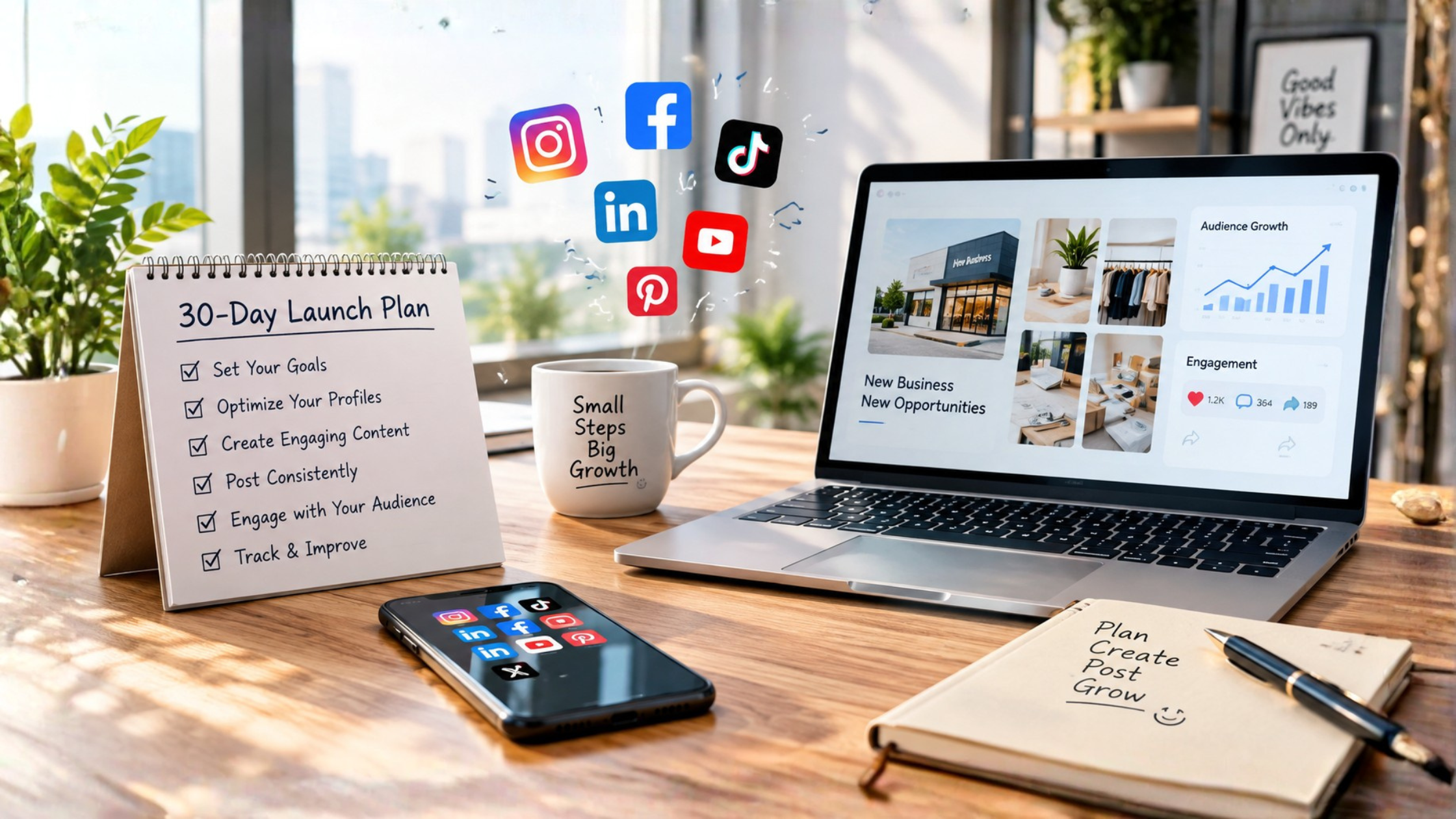
How to Build a Social Media Presence for a New Business: A 30-Day Launch Plan
You registered the business, finished the logo, and opened an Instagram account. Now the profile has zero followers, three posts, and a bio you wrote in two minutes. Every new business starts exactly here, and most advice online assumes you are already further along.
This guide is a plan for the first 30 days. It covers what to set up before you post, which two platforms to start with, how many hours a week it takes, how to show up in social search, and what to do in each of the four weeks. It also covers how to use AI without sounding fake and how to earn credibility when nobody knows you yet.
Short answer: To build a social media presence for a new business, finish your profile setup first, pick two platforms where your customers already spend time, publish 9 to 12 useful posts in the first two weeks, join conversations every day, collect real customer proof, and review your results on day 30. Clarity and consistency matter more than follower count.
What does a strong social media presence actually mean for a new business?
A strong social media presence means the right people can find your business, understand it in a few seconds, and trust it enough to contact you. For a new business, that matters more than follower count. Think of it as being findable, believable, and reachable, with a profile and posts that prove a real person is running the business.
A social media presence is simply everything a stranger sees when they land on your profile: your name, photo, bio, recent posts, comments, and how quickly you reply. Nobody judges these separately. They form one impression, usually in under ten seconds.
That impression is getting more important. In HubSpot's 2026 survey of social media marketers, reported by Forbes Advisor, brand awareness is now the number one goal for 59% of marketers, up from 29% the year before. HubSpot links the change to how people shop: they check social feeds, creator posts, communities, review sites, and AI answer engines before they buy, so being recognized is starting to matter more than being clicked. For a new business, being recognized is the whole problem.
The audience is there. DataReportal figures cited by Forbes Advisor put social media users at 5.79 billion worldwide, and the average person uses about 6.5 platforms a month. Your future customers are not waiting inside one app. They move around, which is why the plan below focuses on being clear and consistent wherever they find you, not on being everywhere.
It also helps to know what a strong presence is not. It is not a big follower number. In the same HubSpot data, brands choosing creators to work with rank follower count only fourth, behind content quality, engagement rate, and authenticity. If professional marketers don't treat followers as the main signal, you shouldn't treat it as your only scoreboard either.
What should you set up before your first post?
Before your first post, set up a consistent name and handle, a clear profile photo, a bio that says who you help and what you do, one link to your website or booking page, and a visible way to contact you. This takes about two hours and shapes every visit to your profile after someone sees a post.
Many new businesses skip this step because posting feels more productive. But every post you publish sends people to your profile, and a half-finished profile wastes that attention. Do the setup once, properly.
Pick one handle and use it everywhere. Check availability on every platform you might use before you commit, because changing a handle later breaks links and confuses customers. If your exact name is taken, add a short word like the city or service rather than numbers or underscores.
Use your search words in the name field. On Instagram, the display name is searchable separately from the username. A bakery called Maple & Rye can set its display name to Maple & Rye | Sourdough Bakery so it can surface when people search for the thing it sells. Other platforms have similar fields, so write the name your customers would type, not only the name on your sign.
Write the bio in four parts. Say who you help, what you do, one piece of proof or a location, and the next step. An example for a made-up home bakery: Handmade sourdough for busy families. Order by Thursday, pick up Saturday. Tap the link to order. It is plain, specific, and tells a stranger what to do.
Use one link that does one job. Send people to a single page: your website, a booking page, or a WhatsApp or messaging link if that is how your customers prefer to buy. Then make sure your website links back to your social profiles so the connection works in both directions.
Make contact easy. Switch to a business or creator account where the platform offers it, because that unlocks contact buttons and analytics. If you serve a local area, set up a Google Business Profile as well and keep the details identical to your social profiles.
Pin your three best posts. Before you have a large library, pin one post about what you do, one about how to order or book, and one customer comment or result you can share honestly. A new visitor then gets the whole story without scrolling.
Which social media platforms should a new business start with?
Start with two platforms, not five. Choose the ones where your customers already spend time and where your content format fits: visual products suit Instagram and Pinterest, local services suit Facebook, B2B suits LinkedIn, and how-to content suits YouTube. Add a third platform only after 60 days of steady posting on the first two.
Spreading across five platforms is the most common way new businesses burn out by week three. Each platform wants slightly different content, and a thin presence on five accounts looks worse than a solid one on two.
To see where audiences are, Pew Research's 2025 survey of U.S. adults, cited by Forbes Advisor, found that 84% use YouTube, 71% use Facebook, 50% use Instagram, 37% use TikTok, and 32% use WhatsApp. These are US figures, so check how your own market differs. Among marketers, HubSpot's 2026 survey found 80% use Instagram, 66% Facebook, 60% YouTube, and 57% TikTok, and Instagram led every performance metric they track, from awareness to leads.
Use these pairings as a starting point, not a rule.
- Product brand (food, fashion, decor): start with Instagram and add Pinterest or TikTok. Photos and short video show the product, and both platforms are used for discovery.
- Local service (salon, clinic, repairs): start with Facebook and add Instagram. You get community groups, local reviews, and easy messaging.
- B2B, consulting, software: start with LinkedIn and add YouTube. Decision-makers are there, and video explains complex offers.
- Coach, educator, creator: start with YouTube or Instagram and add TikTok or YouTube Shorts. How-to content keeps getting found through search.
- Online store: start with Instagram and add TikTok. Short video and shopping features shorten the path to purchase.
If you are torn between formats, our comparison of Instagram Reels, YouTube Shorts, and TikTok looks at which short video format drives more engagement.
Three questions can break a tie. Where do your customers already ask for recommendations? Which format can you realistically make every week? And on which platform do your competitors' posts actually get comments, not just likes? Pick the platform where all three answers line up.
How many hours and how much money does it take?
Most new businesses can build a credible presence with three to five hours a week and no ad budget. Batch your content once a week, reply to comments daily, and spend money only after you know which posts earn real attention. Ten hours a week speeds things up, but it isn't required.
The hours are the real cost, so plan them honestly. These tiers are planning estimates, not measured benchmarks. Pick the one you can keep up for 90 days.
- Lean (about 3 hours a week): 3 posts on the main platform, 1 on the second, and 10 minutes of daily replies. Cash needed: usually none.
- Standard (about 5 hours a week): 4 to 5 posts on the main platform, 2 on the second, daily comments and replies, and a weekly review. Cash needed: usually none.
- Push (about 10 hours a week): 5 or more posts on the main platform, 3 or more on the second, creator outreach, and one repeating video series. Cash needed: optional small spend later.
A simple way to spend a five-hour week is two hours creating and batching content, one hour scheduling and publishing, and two hours on comments, messages, and a short review. Many scheduling and design tools offer free tiers that cover this, but limits change, so check the current terms before you rely on one.
The money question is easier: don't run paid promotion in week one. You can't judge what to promote until you have posts that perform. Once a post clearly works, a small boost can extend its reach. Until then, your best investments are a decent phone setup, good natural light, and the time to reply to people.
How do people find a new business through social search?
Social search means people using TikTok, Instagram, YouTube, or Pinterest to find businesses and answers instead of Google. To appear, put the words customers actually use into your profile name, bio, captions, on-screen text, and spoken lines in videos. Write like a person answering a question, not like someone stuffing keywords.
This is one of the biggest shifts for small businesses, and most beginner guides skip it. A We Are Social report, quoted by National University, says social networks are now the main media channel for people aged 16 to 34 when they research brands online, with scrolling social feeds outpacing text-based search for discovery in that group. The University of Houston Small Business Development Center puts it more broadly: about one in three consumers now start their search on platforms like TikTok, Instagram, and YouTube.
Pinterest shows what commercial intent looks like. In its first-quarter 2026 earnings, as reported by Forbes Advisor, the platform handled more than 80 billion searches a month, roughly half with commercial intent. People there are often looking for something to buy or plan around.
Here is where to put your words so the platform understands what you offer:
- Profile name and bio. The phrase a customer would type, such as sourdough bakery or physiotherapy clinic, plus your area if you serve one.
- Captions. Open with the question or problem in natural language. A caption that begins How do I keep sourdough fresh for a week? matches how people search.
- On-screen text. Add short text to videos that states the topic. Platforms read it, and viewers who watch with the sound off see it.
- Spoken words. Say the topic out loud in the first few seconds of a video. Auto-captions help the platform categorize it.
- Alt text and file names. Add a short description to images where the platform allows it.
Hashtags still work as a secondary signal, but a few relevant ones beat a wall of generic ones. And keep it human. Stuffing keywords into every sentence makes content sound robotic, which is the opposite of what people want to see.
Test your work by typing your own main keyword into the search bar of each app, as a customer would. If competitors appear and you don't, check whether your name, bio, and captions use the same words your customers do.
Google still matters too. Link your social profiles from your website and link your site from your bio, so each one helps people reach the other.
What does the 30-day launch plan look like?
A workable 30-day plan runs in four stages: week one builds your foundation posts, week two starts conversations, week three collects proof from real customers and partners, and week four reviews the numbers so you can keep what worked. It assumes two platforms, three to five hours a week, and no paid promotion.
Treat this as a framework to adapt, not a promise of results. Your industry, your market, and the quality of what you post will change the outcome.
Week 1: Build your foundation (days 1 to 7)
Finish the profile setup from earlier, then publish your first five or six posts. The aim is to give new visitors a reason to follow and a clear picture of who you are. A working target is to have 9 to 12 posts live by the end of week two before you ask people to look at your page.
Good foundation posts answer the questions a stranger has:
- Who we are and why we started. Use a real photo and a real reason.
- The problem we solve. Describe one specific customer problem in plain language.
- How it works. Walk through your product or service in three steps.
- Behind the scenes. Show how you make, prepare, or deliver the work.
- Your most common question. Answer the question you get asked most.
- A myth in your industry. Correct a belief your customers hold that costs them money or time.
Don't announce that you are new and hope for the best. Show the work. A new account that publishes useful posts looks like a business. An account that only says follow us looks like an experiment.
Week 2: Start conversations (days 8 to 14)
Publish another four to six posts, such as tips, a short tutorial, a comparison, a poll, or a question for your audience. Then shift more of your time to talking with people, because new accounts rarely get reach from posting alone.
Spend about 20 to 30 minutes a day leaving thoughtful comments on accounts your customers follow: local businesses, creators in your niche, and industry pages. Add something useful. A comment that says Great post gets ignored, while one that adds a specific tip or question gets noticed.
Tell your personal network, and ask for something small and real, such as a save, a share, or a comment with their honest opinion, not only a follow. Reply to every comment and message. The University of Houston SBDC suggests responding within 24 hours, ideally sooner, because quick replies turn casual followers into an engaged community.
Join two or three communities where your customers already talk, such as Facebook groups, LinkedIn groups, or subreddits. Answer questions without pitching. Your profile link does the selling for you when people click through.
Week 3: Collect proof (days 15 to 21)
By now you have posts and early conversations. Week three is about evidence that real people use and like what you offer.
Ask your first five to ten customers, testers, or clients for honest feedback. Share what they say with their permission, whether it is a review screenshot, a photo of them using the product, or a short message. If you have no customers yet, offer a few people a free trial in exchange for honest feedback, and say clearly that it was a trial.
Start small with partnerships. Marketers choose creators for quality, engagement, and authenticity before follower count, and HubSpot's survey found micro-influencers with 10,000 to 99,000 followers are used by 45% of marketers. For a brand-new business, go smaller still: local creators and neighbors with active audiences in your niche. If you send a free product for a review, follow the platform's rules and local advertising rules on disclosing it.
Week 4: Review and decide (days 22 to 30)
Look at your numbers and make three lists. Which three posts performed best, and what do they have in common? Which three performed worst, and what should you stop? What have people asked in comments and messages that you haven't answered with a post yet?
Then decide what to keep, what to drop, and what to try next. If one platform produced all the conversations, give it more time and treat the other as support. If one format worked, make a series out of it. Write the next 60 days as a simple plan: one main format, one weekly topic theme, and one proof-gathering habit.
If the numbers are small at day 30, that is normal. Judge the month by whether strangers visited, clicked, and talked to you, not by the follower count.
How do you use AI without making your brand look fake?
Use AI for brainstorming, outlines, caption drafts, and repurposing, but keep faces, opinions, results, and customer stories human. Audiences notice generic content, and some surveys show people trust brands less when content feels machine-made. A good test: could a competitor post your caption unchanged? If yes, add something only you know.
AI is now standard. HubSpot's 2026 survey, as reported by Forbes Advisor, found 94% of social media marketers use AI in their workflows in some form, up from 71% the year before. At the same time, 77% of marketers said authenticity beats production value on social. Both can be true. AI speeds up the work, and authenticity decides whether the work succeeds.
Audience sentiment backs this up. Hootsuite's 2026 Social Trends report, cited by National University, found that nearly a third of consumers say they are less likely to choose a brand that uses AI-generated ads. A 2024 Bynder survey, cited by the University of Houston SBDC, found 52% of consumers become less engaged when they suspect content is AI-generated. Surveys differ on exact numbers, so treat these as a direction, not a rule.
A few practical rules keep you on the right side of this:
- Use AI to get unstuck on ideas, to draft captions, and to turn one video into several smaller posts.
- Add your own details before publishing: a real customer question, a number from your business, a photo you took.
- Never use AI to create fake testimonials, fake reviews, or invented results.
- Check every factual claim before posting. AI tools can sound confident and still be wrong.
- Keep your own face and voice in the mix, because a small business with a human behind it is exactly what larger competitors struggle to copy.
How do you build social proof when nobody follows you yet?
Social proof for a new business comes from evidence that real people use and like what you offer: customer reviews, photos and messages shared with permission, partnerships with small creators, and visible activity. Visible numbers can help first impressions, but they only convert when real content and real customers sit behind them.
The strongest early proof is the kind you can point to. Customer reviews, screenshots of kind messages, photos of people using your product, and short videos of the work being done all answer the question a stranger is silently asking: is this business real, and are people happy with it?
Build proof in layers. Start with a complete profile and useful content. Add a few genuine customer voices. Reply to every comment so the page looks alive. Share customer content with permission. Keep posting. Over time these signals support each other, and the result is far more convincing than any single number. Our guide to building social proof for a new brand goes deeper on this layered approach.
Where do paid growth services fit?
Honestly, they are optional, and they are not a substitute for the work above. Services that add likes, views, or followers can change how a page looks at first glance, and some new businesses use them to make early posts look less empty. They do not create customers, and a mismatch between large numbers and no real interaction can look suspicious to visitors.
There is also account risk to weigh. Platforms' rules generally restrict artificial engagement, so read the terms of any platform you use before buying anything from any provider. If you decide to use a service, a cautious approach is to start small, apply it only to content that already performs well organically, and keep investing in real posts and real conversations.
If you want to compare options, you can look at our services or the free offers for Instagram views and Instagram likes. Read each offer's terms before you use it, and treat any service as support for your content, not the strategy itself. For a deeper look at the difference between real and inflated numbers, read Real Engagement vs Vanity Metrics.
What should you track in the first 30 days?
In the first 30 days, track profile visits, link clicks, saves and shares, direct messages, and replies from people in your target market. Follower count is the weakest early signal. Look for any sign that a stranger noticed you, understood you, and took a step toward contacting or buying.
A short weekly review is enough. Write the numbers in a simple sheet and compare week to week.
- Profile visits show whether your posts make people curious enough to check you out. Find them in your platform insights.
- Link clicks show whether your bio and call to action work. Find them in platform insights or a link tool.
- Saves and shares show whether your content is useful enough to keep or pass on. Find them in post insights.
- Direct messages and inquiries show whether people are ready to talk to you. Check your inbox.
- Comments from your target market show whether the right people are noticing you. Read your comment section.
- Follower growth is a secondary signal, not the main goal. Find it in your platform insights.
HubSpot's finding that more brands now put awareness first is a reminder that early results look like recognition: people knowing your name, searching for you, or mentioning you. To connect these signals to revenue over time, see our guide on how to measure social media marketing ROI.
How should you adjust this plan for India, the US, Pakistan, or other markets?
The 30-day plan works anywhere, but platform choice, language, payment habits, and contact channels change by market. Match your content to where customers actually talk to businesses, such as Instagram comments, WhatsApp chats, or Facebook groups, and publish in the language they use day to day.
Three adjustments matter most.
Contact channel. In many markets, customers prefer to message a business on WhatsApp before buying. If that is true for yours, put a WhatsApp link in your bio and answer quickly. In other markets, an email form or booking page works better. Match your call to action to how people in your market actually buy.
Language and tone. Post in the language your customers use at home, even if your website is in English. Mixing languages is fine if your audience does the same. Captions that sound local get more replies than polished translations.
Platform mix. Pew's figures above are for US adults. Check what is popular with your own customers, ask them directly, and look at which platforms local competitors use. If you serve several countries, build the same two-platform base first and add region-specific content later.
If your growth plan targets specific countries, our regional pages for the USA, India, and Pakistan explain how our services work in those markets.
What mistakes slow new business accounts down?
The most common mistakes are starting on too many platforms, posting without a clear message, ignoring comments, copying trends that do not fit, and judging results too early. Most are avoidable with a simple plan and a realistic schedule.
Being on five platforms at once is the biggest. Two done well beat five done thinly. Posting without a goal is next: every post should help someone understand what you do, trust you, or contact you.
Ignoring replies costs more than people expect. A comment left unanswered for days tells a visitor nobody is home. And copying a trend that doesn't fit your business can attract the wrong audience or make you look like you are following instead of leading.
The last one is impatience. Most new accounts look quiet in the first month, and that is normal. The goal for day 30 is a solid foundation, not a viral moment. If you want the broader basics, our beginner's guide to social media marketing covers them.
Your 30-day checklist
Use this to keep yourself on track.
- Before day 1: Same handle everywhere, clear photo, keyword in the name field, four-part bio, one link, contact method set, three posts pinned.
- Week 1: Publish 5 to 6 foundation posts, and check search results for your main keyword.
- Week 2: Publish 4 to 6 more posts, leave useful comments daily, reply within 24 hours, and join two or three communities.
- Week 3: Ask 5 to 10 customers or testers for honest feedback, share it with permission, and contact a few local or micro creators.
- Week 4: Review best and worst posts, keep what worked, drop what didn't, and write a 60-day plan.
- Every week: Record profile visits, link clicks, saves, shares, messages, and comments from your target market.
Final thoughts
A strong social media presence for a new business is built from small, repeatable steps: a clear profile, two well-chosen platforms, useful posts, daily conversations, real proof, and a weekly look at what is working. None of it requires a big budget or a large following. It requires showing up consistently and making it easy for strangers to understand and trust you.
Start this week. Finish your profile, pick your two platforms, and publish your first post. When you are ready to explore growth tools to support your content, you can create an account at InstantLikes or browse the FAQ first.
How long does it take to build a social media presence for a new business?
Expect a visible, credible presence in about 30 days, but not large audience growth. Within a month you can have complete profiles, a base of useful posts, early conversations, and a few real customer signals. Meaningful audience growth usually takes several months of consistent posting, so judge the first month on foundations and engagement quality.
Which platform should a new business start with?
Start with the platform where your customers already look for businesses like yours. Instagram suits visual products and services, Facebook suits local and community-driven businesses, LinkedIn suits B2B, and YouTube suits how-to content. Pick one main platform and one supporting platform, and give both 60 days before judging results.
Can I build a social media presence with zero followers?
Yes. Every account starts at zero. Publish a base of useful posts first, optimize your profile for search, comment on accounts your customers follow, and ask your personal network and first customers for honest engagement. Early reach comes from relevance and conversation more than from existing followers.
How often should a new business post?
A realistic starting point is three to five posts a week on your main platform and one to three on your second, plus daily replies. Choose a pace you can keep for 90 days. Consistent posting beats a burst of daily posts followed by silence.
How many hours a week does social media take for a new business?
Plan for three to five hours a week for two platforms: about two hours to create and batch content, one hour to schedule and publish, and one to two hours for comments, messages, and review. Solo founders can start at three hours and increase once they see what works.
Is it okay to use AI to create social media content?
Yes, as a helper. AI is useful for ideas, outlines, caption drafts, and repurposing. Keep your own voice, real photos, customer stories, and specific details in every post. Check every claim before publishing, and never use AI to invent reviews, testimonials, or results.
How do I get my first customers from social media?
Make it easy to take the next step. Put a clear call to action and link in your bio, answer questions in comments and messages quickly, share how your product or service works, and invite people who show interest to message you. Early customers often come from conversations, not from posts alone.
Do new businesses need to run ads?
No. Paid ads are optional in the first 30 days. Start by publishing useful content and learning which posts get attention. Once a post clearly works, a small paid boost can extend its reach. Ads rarely fix an unclear profile or weak content, so set up the basics first.
Does buying followers or likes help a new business?
It can change how a profile looks at a glance, but it does not create customers, and platform rules generally restrict artificial engagement, so there is account risk. Real content, reviews, and conversations carry the business. If you use any growth service, treat it as a small support for your best content and read the platform's terms first.
What should I track to know if my social media presence is working?
Track profile visits, link clicks, saves, shares, direct messages, and inquiries from your target market, with follower growth as a secondary number. Review them weekly. If strangers are visiting, clicking, and starting conversations, your presence is working even while the follower count is still small.