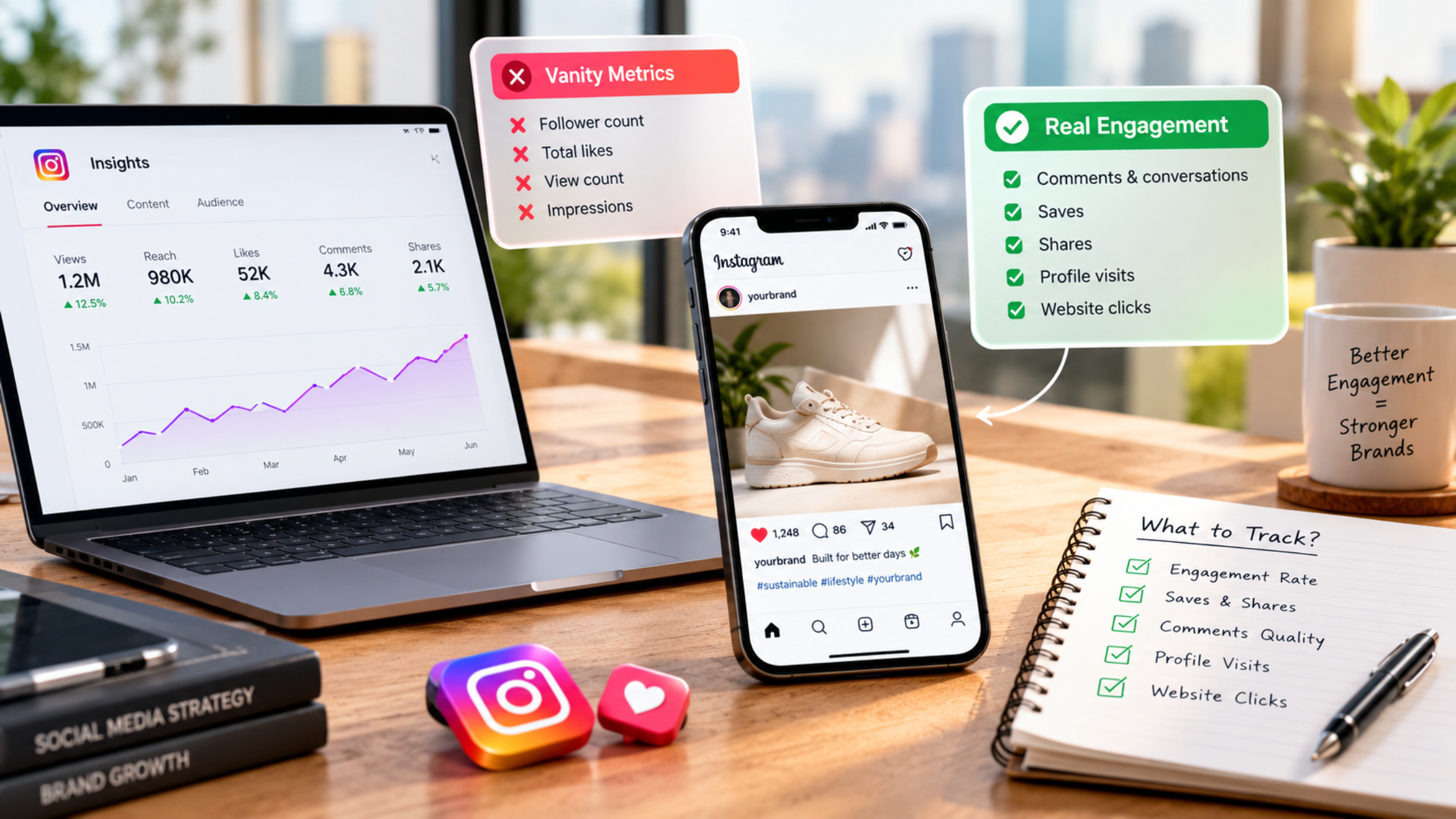
Real Engagement vs Vanity Metrics: What Should Brands Track?
Imagine you have just published a new Instagram Reel for your business. Within a few hours, the numbers start moving. Your post gets thousands of views, hundreds of likes, and your follower count goes up. At first glance, everything looks successful. But then you check your website traffic and sales, and almost nothing has changed.
This is where the difference between Real Engagement vs Vanity Metrics becomes important. Social media can give brands a huge amount of data, but not every number tells you something useful about your customers. A large number can look impressive while saying very little about whether people actually care about your brand.
If you are running a business in the USA, India, Pakistan, or anywhere else in the world, the goal should not simply be to collect bigger numbers. You need to understand what your audience is doing after seeing your content and which interactions are helping your business move forward.
That does not mean likes, views, or followers are useless. They can provide valuable context when interpreted correctly. The real challenge is knowing which numbers deserve attention, how they connect with Social Media Engagement, and how they can guide your next marketing decision.
What Are Vanity Metrics?
Vanity metrics are numbers that can look impressive but do not always explain whether your marketing is achieving its actual business objective. Common examples include total followers, raw video views, impressions, and sometimes the number of likes on a post.
For example, gaining 10,000 followers sounds exciting. But if only a tiny percentage of those followers interact with your content, visit your website, ask questions, or become customers, the follower count alone does not tell the complete story.
The same applies to video views. A Reel can receive thousands of views because people watched it briefly while scrolling, but that does not automatically mean those viewers understood your product or developed an interest in buying it.
Vanity metrics are therefore not necessarily “bad” metrics. They become misleading when brands use them as the only evidence of success. The better approach is to treat them as part of a larger picture.
What Is Real Social Media Engagement?
Real Social Media Engagement is about meaningful actions people take after encountering your content. Depending on the platform and campaign, this can include comments, shares, saves, replies, profile visits, link clicks, direct messages, and other actions that show a stronger level of interest.
Consider two Instagram posts from the same business. The first receives 20,000 views and 100 likes but almost no comments, saves, shares, or profile visits. The second receives 7,000 views but generates 300 comments, 500 saves, and dozens of website visits.
The second post may tell you much more about what your audience actually wants. The content reached fewer people, but the people who saw it showed stronger signals of interest.
This is why brands should look beyond the biggest number on the dashboard. Engagement becomes more useful when you connect it to audience behaviour, content quality, campaign objectives, and business outcomes.
Real Engagement vs Vanity Metrics
The simplest way to understand Real Engagement vs Vanity Metrics is to ask one question: “What does this number help me understand?”
A follower count can tell you how many accounts follow your profile, but it does not explain how many followers are active or interested in your latest product. A view count tells you that content was viewed, but it does not necessarily explain what happened after that view.
Comments, shares, saves, profile visits, messages, and link clicks often provide additional context. They can help you understand whether people found the content interesting enough to respond, remember, share, investigate, or take another action.
The exact importance of each metric depends on your goal. A brand campaign focused on awareness may care heavily about reach and impressions, while an e-commerce campaign may care more about clicks, product-page visits, conversions, and revenue.
Why Engagement Rate Matters
Engagement Rate is one of the most useful ways to put social media interactions into context. Instead of looking only at the number of engagements, it helps you understand those interactions relative to an audience or exposure measure.
There are several ways to calculate engagement rate, including calculations based on followers, reach, or impressions. For example, a common formula is total engagements divided by reach, multiplied by 100. Different platforms and analytics tools may use different definitions, so brands should always check the formula before comparing numbers.
This matters because raw numbers can be misleading. A brand with one million followers might receive 5,000 interactions, while a smaller brand with 20,000 followers could receive 2,000 interactions. Looking only at the totals would miss the difference in audience response.
Engagement rate is not a perfect measure either. It should be reviewed alongside content reach, audience quality, clicks, conversions, and the objective of the campaign. Industry and platform differences also mean there is no single engagement-rate number that is automatically “good” for every brand.
Likes Are Useful, But They Are Only One Signal
Likes are one of the easiest social media metrics to understand. When someone likes your post, it generally indicates that they had a positive enough reaction to interact with it.
However, a like usually requires less effort than writing a thoughtful comment, saving useful information, sharing a post with friends, or clicking through to a website. That does not make likes unimportant; it simply means they should be interpreted alongside other signals.
For example, if one type of Instagram post consistently receives more likes but another type generates more saves and website visits, the second format may be more valuable for a business focused on long-term customer interest.
Brands should therefore avoid asking only, “How many likes did we get?” A better question is, “What did people do after engaging with this content?”
Views Can Tell You About Reach
Views are especially important for short-form video because they help brands understand how much exposure their content receives. If a Reel, TikTok, or YouTube Short receives more views than your normal posts, that can indicate that the content reached a larger audience.
But views should not be confused with attention or conversion. A person can watch a video briefly and continue scrolling without remembering the brand, visiting its profile, or taking any further action.
That is why video performance should be evaluated using additional metrics such as average watch time, retention, shares, comments, saves, profile visits, clicks, and conversions when those measurements are available.
A useful question is not simply, “How many people watched this?” It is also, “Did the people who watched it stay, respond, share it, or take the next step?”
Followers: Growth Is Useful, But Quality Matters
Follower growth can be an important part of Social Media Growth. A larger relevant audience can give your future content more opportunities to reach people who already have an interest in your brand.
The problem starts when follower count becomes the main definition of success. A business can increase its follower number without creating a stronger relationship with its audience.
For example, gaining followers who never interact with your content may make your profile look larger, but it may not improve conversations, website visits, leads, or sales. On the other hand, a smaller audience that consistently engages with your content can provide valuable feedback and stronger commercial opportunities.
For this reason, brands should track follower growth together with engagement rate, audience activity, profile visits, clicks, and conversions instead of treating follower count as the final result.
Comments, Shares, and Saves Can Reveal More
Not all interactions carry the same level of intent. A like can show a quick positive reaction, while a comment may indicate that someone wants to participate in the conversation.
Shares can be particularly useful because someone has decided that your content is worth passing to another person. Saves can also provide an important signal when people want to return to the information later.
Current social media measurement guidance similarly recommends looking at engagement quality rather than only engagement volume. Comments, shares, and saves can provide additional insight into how people are responding to content.
This does not mean you should create a rigid ranking where one engagement is always better than another. The value depends on your goal. A tutorial may naturally generate more saves, while a controversial industry question may generate more comments.
Track Metrics Based on Your Goal
One of the biggest mistakes brands make is tracking every available number without deciding what they actually want to achieve.
If your goal is brand awareness, reach, impressions, video views, audience growth, and profile visits may be useful. These metrics can help you understand how widely your content is being discovered.
If your goal is engagement, focus more closely on comments, shares, saves, likes, replies, and engagement rate. If the goal is website traffic, link clicks, landing-page visits, and click-through rate become more important.
For e-commerce and lead-generation campaigns, the conversation should eventually move toward business outcomes. Track enquiries, leads, purchases, conversion rate, revenue, or other actions that connect social activity with your commercial objective.
A Simple Example for a Small Business
Imagine you run a clothing brand in India and publish two Instagram Reels during the same week. The first Reel gets 30,000 views and 900 likes. The second receives 12,000 views, 500 likes, 120 saves, 70 shares, and several website visits.
If you only report views and likes, the first Reel looks like the obvious winner. But the second Reel may have generated stronger audience interest because people saved it, shared it, and visited your website.
This example shows why Social Media Engagement needs context. A post does not necessarily become more valuable simply because more people saw it.
The right measurement depends on what you wanted the content to accomplish. If the first Reel was designed purely for awareness, its high reach may be useful. If the second was designed to drive product interest, its deeper actions may matter more.
What About Free Instagram Likes and Free Instagram Views?
Businesses and creators often search for tools such as Free Instagram Likes or Free Instagram Views when they are trying to understand social media promotion. These tools can be useful for exploring available resources and learning how different social media services work.
However, free tools should not become the main measurement strategy for a serious marketing campaign. A number displayed on a profile does not automatically tell you whether your audience trusts the brand, understands the product, or intends to buy.
If you use promotional services, keep your analytics separate from the service itself. Continue tracking organic engagement, audience behaviour, website activity, content performance, and business outcomes.
The same principle applies to Free YouTube Likes. Likes can contribute to the visible engagement around a video, but brands should also examine watch time, audience retention, comments, shares, subscribers, clicks, and conversions when measuring YouTube performance.
Where SMM Panel Services Fit
An SMM Panel can be useful when a brand, creator, marketer, or agency wants access to specific social media services through an online platform. Depending on the provider, services may cover Instagram, YouTube, TikTok, Facebook, X, Telegram, Discord, and other platforms.
The important point is that SMM Panel Services should not be treated as a replacement for analytics. An SMM Panel can support service delivery, but your business still needs its own performance measurement system.
For example, if you use an SMM service to support visibility around a campaign, you should continue monitoring the metrics that matter to your business. Look at engagement rate, audience response, profile activity, website traffic, leads, and conversions rather than assuming a higher number automatically means better performance.
Used thoughtfully, an SMM Panel can become one part of a wider social media workflow instead of becoming the definition of success.
How an SMM Reseller Panel Can Help Agencies
The measurement issue becomes even more important for digital marketing agencies. An agency may manage social media services for multiple clients, each with different goals and different definitions of success.
An SMM Reseller Panel can help agencies organize service delivery across multiple customers. Depending on the provider, reseller systems may include automated ordering, API integration, service management, and other features designed to reduce repetitive operational work.
But the agency still needs to report meaningful results to its clients. A client selling products in the USA may care about leads and sales, while a creator in Pakistan may care more about audience growth and engagement.
For agencies serving customers across India, the USA, Pakistan, the UK, Canada, Australia, and other markets, the key is to connect service activity with the client's actual objective rather than presenting large numbers without context.
What Brands Should Track in 2026
Social media measurement in 2026 is becoming more focused on understanding what content actually achieves. Current industry guidance continues to group metrics around engagement, reach, conversions, customer response, and return on marketing activity rather than relying on one number.
A practical dashboard does not need hundreds of metrics. Start with a small group that matches your goals: reach, engagement rate, comments, shares, saves, profile visits, clicks, follower growth, and conversions where relevant.
Then compare those numbers over time. One post rarely tells the complete story, but patterns across several weeks or months can reveal which topics, formats, messages, and campaigns consistently perform better with your audience.
This approach also makes it easier to explain results to clients or internal teams. Instead of saying, “Our post got 50,000 views,” you can explain what happened after those views and whether the campaign moved closer to its actual business objective.
How to Build a Better Social Media Measurement Strategy
Start by choosing one clear goal for each campaign. Do not begin with the metrics available in your dashboard; begin with what you want the audience to do.
Next, choose a small group of metrics that can help answer whether you achieved that goal. For awareness, look at reach and exposure. For engagement, examine interactions and engagement rate. For traffic, track clicks and website activity.
After the campaign ends, compare the results with previous content instead of relying on a universal benchmark. Your own historical data can help you understand what is normal for your account and where meaningful changes are happening.
Finally, look for patterns. If tutorial content consistently receives more saves, product demonstrations generate more clicks, and customer stories receive more comments, you now have useful information for planning your next campaign.
Final Thoughts
The real lesson behind Real Engagement vs Vanity Metrics is simple: numbers are useful only when they help you understand something important.
Followers, likes, and views can show visibility and audience growth, but they should not automatically be treated as proof that a marketing campaign succeeded. Meaningful engagement becomes clearer when you look at comments, shares, saves, clicks, profile visits, engagement rate, and eventually business outcomes.
For brands in the USA, India, Pakistan, and markets around the world, this approach can make social media reporting more practical. Instead of chasing the biggest number, you can focus on understanding what your audience actually responds to and which content deserves more attention.
SMM Panel Services, Free Instagram Likes, Free Instagram Views, Free YouTube Likes, and other social media tools can have a supporting role in a wider marketing workflow. However, they should sit alongside a proper measurement strategy rather than replace it.
At InstantLikes, businesses, creators, marketers, and agencies can explore social media services according to their individual requirements. Whether you are managing one account or building a larger reseller operation, use your service data together with real audience and business data to make smarter marketing decisions.
In the end, the goal is not to make your dashboard look impressive. The goal is to understand your audience better, create content they actually value, and turn social media activity into measurable progress for your business.
1. What is the difference between real engagement and vanity metrics?
Real engagement focuses on meaningful audience actions such as comments, shares, saves, clicks, messages, and other behaviours that reveal audience interest. Vanity metrics such as follower counts, raw views, or impressions can show reach but may not explain whether people actually connected with the brand.
2. Is engagement rate more important than follower count?
They measure different things. Follower count shows the size of an account's audience, while engagement rate provides context about how actively people interact with content. A brand should use both where relevant rather than relying on either metric alone.
3. Are likes and views useless for social media marketing?
No. Likes and views can be useful indicators of exposure and audience response. The problem is relying on them alone. Brands should combine them with comments, shares, saves, clicks, engagement rate, website activity, leads, or sales depending on the campaign goal.
4. What social media metrics should brands track in 2026?
The right metrics depend on the objective, but common metrics include reach, impressions, engagement rate, likes, comments, shares, saves, follower growth, profile visits, link clicks, conversions, and revenue-related outcomes where measurable. Current 2026 measurement guidance also emphasizes connecting metrics to specific business goals.
5. Can an SMM Panel help with social media growth?
An SMM Panel can provide access to selected social media services, but it should not be treated as a complete growth strategy. Sustainable social media growth also depends on content quality, audience relevance, consistency, engagement, analytics, and a clear marketing objective.
6. Should businesses use Free Instagram Likes or Free Instagram Views?
Free tools can be useful for exploring social media resources, but businesses should not use likes or views as their only measure of success. It is more useful to combine visibility metrics with engagement, audience behaviour, website activity, leads, and conversions.