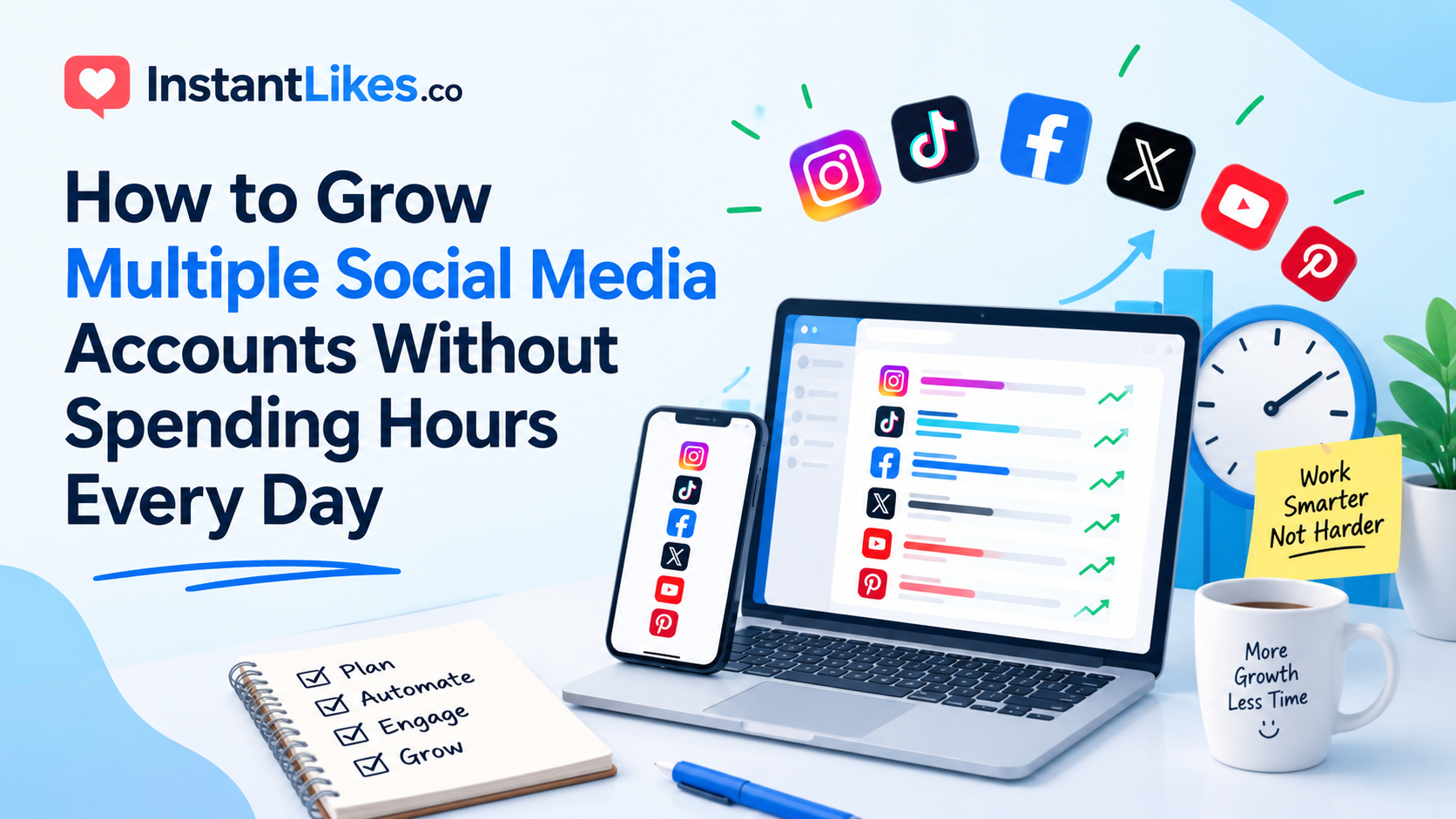
How to Grow Multiple Social Media Accounts Without Spending Hours Every Day
Managing one social media account can be a lot of work. Now imagine handling Instagram, Facebook, YouTube, TikTok, and X for several different brands. You have to create content, write captions, schedule posts, reply to comments, check analytics, and somehow find time to plan your next campaign. If you are a small business owner or a social media manager, this can quickly feel like a full-time job.
The good news is that you do not need to spend hours every day on every account to build a consistent online presence. With the right Social Media Marketing strategy, content scheduling, simple automation, and useful SMM Services, you can manage multiple accounts in a more organized way. The goal is not to post more just for the sake of posting. The goal is to make your daily work easier while keeping your content useful and your audience connected.
In this guide, we will look at practical ways to grow multiple social media accounts without burning out. Whether you are running a business in the USA, managing clients in Pakistan, building a brand in India, or serving customers worldwide, these strategies can help you save time and make better use of your marketing resources.
Why Managing Multiple Social Media Accounts Feels So Difficult
Let us take a simple example. Imagine you run a small digital marketing agency with five clients. One client sells clothing, another runs a restaurant, one creates YouTube videos, and two are local service businesses. Each client needs different content, different posting times, and a different audience.
If you manage everything manually, you may spend your morning creating Instagram posts, your afternoon writing Facebook captions, and your evening checking YouTube analytics. By the time you finish, there is little energy left for strategy or new ideas. This is how social media management becomes stressful.
The problem is often not the number of accounts alone. It is the lack of a repeatable system. When every post is created from scratch and every task is handled separately, your workload grows quickly. A good system helps you reuse ideas, schedule content, automate repetitive tasks, and focus your attention on the work that actually needs you.
1. Create One Content Plan for All Your Accounts
The first step to saving time is to stop treating every social media account as a completely separate project. Instead, create one monthly or weekly content plan that covers all your brands and platforms. This gives you a clear view of what needs to be published, what content is already ready, and which accounts need more attention.
For example, if you manage a clothing brand, you might plan content around new arrivals, styling tips, customer questions, product videos, and special offers. The same main idea can be adapted into an Instagram Reel, a Facebook post, a YouTube Short, and an X update. You are not copying the same post everywhere. You are using one idea in different ways.
A simple content calendar can include the account name, platform, content topic, format, caption status, scheduled date, and performance notes. You can manage this in a spreadsheet, project management tool, or social media scheduling platform. Once the plan is ready, you no longer need to spend every morning wondering what to post.
2. Use Content Batching to Save Hours
Content batching means creating several pieces of content during one focused session instead of making one post every day. This is especially useful when you manage multiple social media accounts because it reduces the time lost switching between tasks.
Suppose you manage three Instagram accounts. Instead of opening Canva, creating one design, writing a caption, publishing it, and repeating the same process tomorrow, you can spend two hours creating a group of designs. Then spend another session writing captions and preparing hashtags. The work becomes faster because you stay focused on one type of task.
You can batch different parts of your workflow, including:
- Recording several short videos in one session.
- Designing multiple social media graphics together.
- Writing captions for the entire week.
- Preparing YouTube Shorts and Instagram Reels from related content.
- Collecting ideas for the next month.
This method does not mean every account should look identical. Each brand should still have its own voice, colors, audience, and content style. Batching simply helps you organize the work so you are not starting from zero every day.
3. Schedule Posts Instead of Publishing Everything Manually
One of the easiest ways to save time is to use a social media scheduling tool. Instead of logging into every account at different times, you can prepare content in advance and schedule it for publication.
For example, a small business owner in India may prepare Instagram and Facebook content on Sunday evening. A creator targeting audiences in the USA may schedule YouTube Shorts and TikTok content for the week. An agency can prepare approved posts for several clients and organize them in one workflow.
Scheduling is helpful because it creates consistency. You do not have to remember every posting time, and you can see your upcoming content before it goes live. In 2026, scheduling remains an important part of efficient social media marketing. HubSpot's 2026 Social Media Marketing Report found that 94% of surveyed social media marketers use AI in their workflows in some capacity, while scheduling tools are highlighted as a practical way to keep content organized.
However, automation should not mean forgetting your accounts. Check your scheduled content, review important comments, and make changes when current events or audience needs require it.
4. Repurpose One Good Idea Into Several Posts
Creating original content for every platform can take a lot of time. A smarter approach is to repurpose strong ideas into different formats. This lets you reach people on multiple platforms without creating everything from scratch.
Imagine you create a YouTube video about five ways to improve Instagram engagement. That one video can become a YouTube Short, an Instagram Reel, a Facebook post, an X thread, and a short blog section. Each version should be adapted to the platform rather than copied without changes.
For example, your Instagram Reel might focus on one quick tip. Your Facebook post could explain the tip in more detail. Your YouTube video could cover the full strategy, while your X post could ask a question that encourages discussion. The same topic becomes several useful pieces of content.
This is especially helpful for agencies and SMM reseller panel users who manage multiple brands. A repeatable content repurposing process helps you deliver more content without increasing your workload at the same rate.
5. Use AI Tools for Repetitive Tasks, Not Your Entire Strategy
AI tools can help reduce the time spent on brainstorming, caption writing, content outlines, and basic editing. They are useful when you have several accounts and need to generate ideas quickly. But you should still review the content before publishing it.
For example, you can ask an AI writing tool to suggest ten Instagram Reel ideas for a fitness brand. Then you can select the ideas that match the brand's audience and turn them into a weekly content plan. You can also use AI to create caption variations, summarize a long video, or organize content ideas.
The important point is that AI should support your creativity rather than replace it. A generic caption may sound fine, but it might not match the personality of a restaurant, clothing brand, or technology company. Your own experience, knowledge of the audience, and brand voice still matter.
In 2026, this balance is becoming more important. HubSpot reports that 77% of surveyed social media marketers say authenticity is more important than production value, and 45% identify consistently producing high-quality content as a top challenge. Use AI to save time on repetitive work, but keep the final content relevant and human.
6. Choose the Right Platforms Instead of Trying to Be Everywhere
Managing every social media platform is not always the best use of your time. If you are handling multiple accounts, it is better to focus on the platforms where your audience is active and where your content fits naturally.
For example, a fashion brand may focus on Instagram Reels, Facebook, and TikTok. A B2B agency may give more attention to LinkedIn and YouTube. A creator who teaches software skills may find that YouTube is the main platform, while Instagram and X help distribute shorter content.
This does not mean you should ignore other platforms forever. It means you should prioritize. Start with two or three platforms per brand and build a consistent system before expanding. If a platform is not producing useful results or does not match your audience, you can review its role later.
For worldwide businesses, audience differences also matter. A brand targeting customers in the USA may use different language, posting times, and examples than one targeting users in Pakistan or India. Your workflow can be shared, but your content should still feel relevant to the people you want to reach.
7. Use SMM Services as Part of a Wider Growth Strategy
SMM Services can support certain social media marketing goals, especially when you want to explore services related to visibility, engagement, or account promotion. However, they should be used carefully and should not replace content quality or genuine audience relationships.
For example, a creator may use an SMM Panel Service to explore available Instagram views or YouTube services while also improving video quality and publishing consistently. A small business may review Facebook or Instagram services as part of a wider promotional campaign. The key is to understand what each service is designed to do.
When looking for the Best SMM Panel, compare service descriptions, pricing, delivery information, support, and relevant policies. Avoid choosing a provider only because it promises huge numbers at a very low price. A suitable service should fit your goal and budget.
At InstantLikes, users can explore SMM Panel Services and available social media service options through the website. Before placing an order, review the current service details and choose the option that matches your actual marketing needs.
8. Explore Free Services Carefully
If you are managing multiple accounts with a limited budget, free services may be worth exploring. For example, Free Instagram Followers, Free Facebook Followers, and Free YouTube Subscribers may appear in the available service categories of some SMM panels.
These options can be useful for understanding what a provider offers, but you should not assume that free services guarantee genuine followers, long-term engagement, or business growth. Always check the service description, terms, and delivery conditions before using them.
A better strategy is to combine careful service selection with consistent content and audience engagement. If you are growing a YouTube channel, focus on useful videos and strong titles. If you are managing an Instagram brand, create content that gives people a reason to follow. Services should support your workflow, not become the entire strategy.
9. Use an SMM Reseller Panel to Manage Client Orders
If you run a digital marketing agency or sell social media services to clients, an SMM reseller panel can help organize your work. Instead of managing every order manually, you may be able to use a central dashboard for service selection, order tracking, and other reseller functions, depending on the provider.
Imagine an agency in Pakistan managing clients in the USA, India, and other countries. Each client may need different social media services, different deadlines, and different reporting. A reseller panel can help the agency keep these orders organized and reduce repetitive manual tasks.
Before choosing an SMM reseller panel, check whether it provides the features your business actually needs. These may include order management, service information, support, and API integration if available. Test the workflow before taking on a large number of clients.
Remember that automation does not remove the need for client communication. You still need to explain what services do, set realistic expectations, and review orders before delivery.
10. Create a Simple Daily and Weekly Routine
A good routine can make managing multiple social media accounts much easier. Instead of spending random hours throughout the day, divide your work into focused blocks. This gives you more control over your time and helps prevent small tasks from taking over your entire schedule.
For example, you could spend Monday planning content, Tuesday creating graphics and videos, Wednesday writing captions, and Thursday scheduling posts. Friday can be used for analytics, client updates, and improving next week's strategy. Your daily routine can then focus on checking important messages, reviewing scheduled posts, and responding to the audience.
Here is an example of a simple daily routine:
- 15 minutes: Check notifications, comments, and urgent messages.
- 20 minutes: Review scheduled posts and make any necessary updates.
- 20 minutes: Work on content creation or editing.
- 15 minutes: Check analytics or record important results.
- 10 minutes: Save new content ideas for future posts.
You can adjust these times depending on the number of accounts you manage. The purpose is to create a repeatable workflow rather than follow a strict schedule that does not fit your business.
11. Track Performance Without Checking Every Account All Day
You do not need to open every social media account several times a day to understand whether your strategy is working. A weekly analytics review can help you identify what is performing well and what needs improvement.
For example, if Instagram Reels are bringing more profile visits, you may decide to create more short videos. If a Facebook post is receiving comments from the right audience, you can explore similar topics. If YouTube videos are getting views but few returning viewers, you may need to improve your content quality or topic selection.
Track a few important metrics, such as:
- Reach and impressions.
- Video views and watch time.
- Engagement rate.
- Profile visits.
- Website clicks.
- Inquiries or conversions.
The right metrics depend on your goal. A creator may focus on watch time and subscribers, while a business may care more about website traffic and sales. Avoid measuring success only by follower count.
12. Review Your Workflow Every Month
Even a good system can become inefficient over time. That is why it helps to review your workflow every month. Look at how much time you spent creating content, scheduling posts, managing comments, and checking analytics.
Ask yourself a few simple questions. Which tasks took the most time? Which accounts needed the most attention? Which content formats performed well? Could you batch more work or remove unnecessary steps? These questions can help you improve your process without adding more tools.
For example, if you notice that creating captions takes too long, you can prepare caption templates for common content types. If editing videos is slowing down your agency, you can create a repeatable editing workflow. Small improvements can make a big difference when you manage several accounts.
The goal is not to automate every part of social media. The goal is to create enough structure that you have more time for creativity, strategy, and genuine audience engagement.
How InstantLikes Can Support Your Social Media Workflow
Managing multiple social media accounts requires planning, consistency, and the right tools. At InstantLikes, users can explore SMM Panel Services and social media marketing options designed to support different account and promotional needs.
Whether you are a creator, a small business owner, a digital marketing agency, or an SMM reseller, you can review the available services and choose according to your goals. InstantLikes serves a worldwide audience, including users and businesses in the USA, Pakistan, India, and other markets.
The best way to use an SMM panel is to combine suitable services with strong content, regular scheduling, and realistic expectations. Explore the available services at InstantLikes and build a workflow that helps you manage your accounts more efficiently.
Final Thoughts
Growing multiple social media accounts does not have to mean spending your entire day online. With a clear content plan, batching, scheduling, smart automation, and suitable SMM Panel Services, you can create a workflow that saves time and keeps your accounts active.
The key is to focus on quality and consistency rather than trying to do everything at once. Choose the platforms that matter, understand your audience, and use tools that reduce repetitive work. If you manage client accounts, an SMM reseller panel can also help organize your services and orders.
Start with a simple system, improve it every month, and use your time where it matters most. Your social media accounts can grow without taking over your entire day.
1. How can I manage multiple social media accounts efficiently?
Use a content calendar, batch your content creation, schedule posts in advance, and track your results weekly. These steps help reduce repetitive work and keep your accounts organized.
2. What tools help automate social media management?
Social media scheduling platforms, content calendars, analytics tools, and AI writing or editing tools can help automate repetitive tasks. Choose tools that match your number of accounts and workflow.
3. Can SMM Services help me grow multiple accounts?
SMM Services may support certain visibility or engagement goals, depending on the provider and service. They should be used alongside good content, audience engagement, and a clear marketing strategy.
4. What is an SMM reseller panel?
An SMM reseller panel is a platform that allows agencies and resellers to manage and purchase social media services through a dashboard. Features vary by provider and may include order management and API tools.
5. How much time should I spend on social media every day?
There is no fixed amount of time that works for every account. A small business may need a short daily check, while an agency managing many clients may need longer focused work sessions. Scheduling and batching can help reduce daily workload.